<?xml version="1.0" encoding="utf-8"?><feed xmlns="http://www.w3.org/2005/Atom" ><generator uri="https://jekyllrb.com/" version="4.4.1">Jekyll</generator><link href="https://j4yc33.neocities.org/feed/LARP.xml" rel="self" type="application/atom+xml" /><link href="https://j4yc33.neocities.org/" rel="alternate" type="text/html" /><updated>2026-09-09T18:39:10+02:00</updated><id>https://j4yc33.neocities.org/feed/LARP.xml</id><title type="html">J4YC33’s Space | Larp</title><subtitle>A small human-made website full of J4YC33&apos;s Ramblings!</subtitle><entry><title type="html">Who am I? Historically…</title><link href="https://j4yc33.neocities.org/LARP/persona.html" rel="alternate" type="text/html" title="Who am I? Historically…" /><published>2026-09-09T18:39:10+02:00</published><updated>2026-09-09T18:39:10+02:00</updated><id>https://j4yc33.neocities.org/LARP/persona</id><content type="html" xml:base="https://j4yc33.neocities.org/LARP/persona.html"><![CDATA[<h1 id="building-a-persona">Building a Persona</h1>

<p>Honestly, trying to build characters for Role Playing Games has always been a thing that made me think about who I am. Whether because I wanted to play myself, or because I intentionally wanted to <em>not</em> play myself. Doing this to get established in the SCA is an entirely different level of helpful.</p>

<p>I have built Personae for LARPs (3 for Amtgard), Several dozen D&amp;D Characters based on Real-World times, and this will be my second Persona for History-based LARPing, but my first for the SCA.</p>

<h2 id="how-to-build-a-persona">How to Build a Persona</h2>
<p>Building an SCA, or other LARP, persona is not unlike building a Dungeons and Dragons character … but your sourcebooks are actual history. There is a general step-by-step process to go through, and kitting your character out is an entirely different level of challenging. The process follows a series of steps that I am going to document here as I get established to build a persona and become a new person in the <a href="https://www.knightscrossing.org">Barony of Knight’s Crossing</a>.</p>

<p>It is not uncommon to have multiple personae.</p>

<p>without further ado, however, why not take a look at the <a href="/Persona/0-Process.html">process</a> of making a persona?</p>]]></content><author><name></name></author><summary type="html"><![CDATA[Building a Persona]]></summary></entry><entry><title type="html">MATH?! In MY hobby!?!</title><link href="https://j4yc33.neocities.org/LARP/TheMathOfWeavingandSpinning.html" rel="alternate" type="text/html" title="MATH?! In MY hobby!?!" /><published>2026-09-09T18:39:10+02:00</published><updated>2026-09-09T18:39:10+02:00</updated><id>https://j4yc33.neocities.org/LARP/TheMathOfWeavingandSpinning</id><content type="html" xml:base="https://j4yc33.neocities.org/LARP/TheMathOfWeavingandSpinning.html"><![CDATA[<h1 id="some-notes-on-spinning-and-weaving-math">Some Notes on Spinning and Weaving Math.</h1>

<p>So, to make a tunic for my measurements, I need about 1.8 meters of fabric 90 centimeters wide. With this, and some facts about the thread, I can calculate how much I need to spin.</p>

<h2 id="how-much-thread-by-weight">How much thread by weight</h2>
<p>Realistically, fabric requires hundreds to thousands of meters of thread to make. This is unwieldy to measure by length as I don’t have several kilometers to lay it out (Also, handspun thread has a problem with unspinning if not handled carefully). This makes measuring all of the length impractical, but I can easily measure it by weight.</p>

<p>So first, I need some base weights:</p>

<ul>
  <li>How much does the spindle weigh?
    <ul>
      <li>We need this to Subtract from the total weight of the Cop and the Spindle</li>
      <li>Lets call this Ws</li>
    </ul>
  </li>
  <li>How much does a meter of thread weigh?
    <ul>
      <li>We need this to determine the total length in the Cop</li>
      <li>We will call this Wm</li>
    </ul>
  </li>
  <li>How much is the total weight of the Cop and the Spindle?
    <ul>
      <li>We need this to determine how much the Cop Weighs</li>
      <li>We will call this Wtot</li>
    </ul>
  </li>
</ul>

<p>With these variables we can calculate the weight of the Cop (Wc) and use that to calculate our total length of thread (Tl)</p>

<p>So, The spindle is made of 2 pairs of chopsticks, a single chopstick, and 2 elastic bands. This material weighs approximately 15 grams. Thus, Ws=15g
3.2 meters of thread weighs approximately 1 gram. I wove a swatch of fabric 4x5cm with this fabric using approximately 3.2 meters of thread. This swatch weighs 1 gram. 
The weight of the spindle with a cop of yarn on it weighs 56g. Thus, Wtot=56g
With this we can calculate the Weight of the Cop as 56g-15g=41g. Thus, Wc=41g.
Using this weight, we can calculate our total length of yarn by multiplying Wc by Wm or 41*3.2 giving us a value of 131.2 which we have, in our reckoning, converted to meters.</p>

<p>Thus, from the math above we can work out that we have 131.2 meters of thread with 41g of fur spun. Accommodating for rounding error, I think it is probably closer to 130 meters.</p>

<p>Update 28.04.2026 - I got my swift and yarn ball winder and have measured out (more accurately) that I have around 110 Meters of usable yarn from my spinning. This accounts for some loss in the winding and finishing process.</p>

<h2 id="how-much-thread-do-we-need-for-a-tunic">How much thread do we <em>need</em> for a Tunic</h2>
<p>In order to work out the amount of thread needed for a tunic, we need to work out how much warp we need, and then we can double that because of the associative and commutative properties of Multiplication.[1] For the warp we need to prepare 2 meters. This allows us 20 centimeters (.2 meters) of extraspace for the head weave to attach to the loom, and some extra for cutoff and preparation. This means we have a length requirement of 200 centimeters per thread. In order we need to work out the number of threads we need for our weave width we need to work out our ends per inch. We can do this two ways:</p>

<ol>
  <li>Weave a small swatch at least 2 cm wide and count the threads</li>
  <li>Wrap the thread around a 2 cm measuring stick and count the thread loops to fill the gap</li>
</ol>

<p>I have done both!</p>

<p>My woven swatch has approximately 15 ends per 2 cm, and my wrap test (tightly wrapped) gives me 16 ends per 2 cm. Together, the numbers agree that I am looking at between 7.5 (which we must round up to 8) and 8 ends per cm. Multiplying this by our width of 90 cm we get 720 threads to make our warp. Multiplying this by our required 200 cm length, we arrive at 148000 cm of thread. Converting this into a much less scary and more manageable number of meters, we divide by 100 and get 1480 meters of thread to make our warp. The calculation for the weft is done the same way, allowing us to double the number to give us our total required thread:</p>

<p>2960 Meters of thread, or 3000 Meters of thread incorporating some safe rounding error correction and accommodating for breaks, tears, knots, and other things we will have to fix in the weaving process.</p>

<h2 id="how-long-will-this-take">How long will this take</h2>
<p>It has taken me approximately 3 hours of spinning to come to 130 meters of thread. I am not a fast spinner, but I am also not the slowest. This means I will need to spin somewhere around 60 hours of time to weave this tunic, or somewhere between 20 and 80 days of just spinning when I feel like it. I could probably speed up the calendar time if I dedicated a few hours of free time a day to this.</p>

<p>However, I don’t think my time is the limiting factor. In one session of grooming, my doggo yields around 70-80 grams of fur. If the above equations hold, that is about 300 meters per grooming session. Which means that it will take <em>at least</em> 10 weeks of grooming to get the fur I need.</p>

<p>I either need more dogs, or some other fiber to cut this with…</p>

<h2 id="a-thought-on-fur-growth">A thought on Fur growth</h2>
<p>I think we are at the tail end of a big shed for Atlas, meaning he is starting a slump of fur production. I might start tracking his fur production to see what times of year he is the most fuzzy.</p>

<h2 id="footnote">Footnote</h2>
<p>[1] To calculate Warp length you need the variables for Width of Material in Centimeters(W), Ends per Centimeter(EPcm), and Length of Total Weave including cutoff(L). The equation is W*EPcm*L. To Calculate Weft Length you use those same variables in the form L*EPcm*W. Thus, both answers are identical and the total length for a woven material can be calculated as W*L*EPcm or roughly the Ends per Centimeter of the area of the weave in Centimeters squared.</p>]]></content><author><name></name></author><summary type="html"><![CDATA[Some Notes on Spinning and Weaving Math.]]></summary></entry><entry><title type="html">Historical Reenactment</title><link href="https://j4yc33.neocities.org/LARP/Resources.html" rel="alternate" type="text/html" title="Historical Reenactment" /><published>2026-09-09T18:39:10+02:00</published><updated>2026-09-09T18:39:10+02:00</updated><id>https://j4yc33.neocities.org/LARP/Resources</id><content type="html" xml:base="https://j4yc33.neocities.org/LARP/Resources.html"><![CDATA[<h1 id="historical-reenactment-resources">Historical Reenactment Resources</h1>
<p>These are resources I have found for researching historical periods common for building SCA/GLG Personas.</p>

<h2 id="general-resources-and-collections">General Resources and Collections</h2>

<ul>
  <li><a href="https://sagy.vikingove.cz/en/articles/">Reenactment and Science</a>
    <ul>
      <li>A fascinating website with a large number of well-researched articles for reenacting and Historically accurate LARPing.</li>
    </ul>
  </li>
  <li><a href="https://www.youtube.com/@ModernKnight">Modern Knight Youtube</a>
    <ul>
      <li>A fascinating Youtube channel discussing Medieval England and life therein</li>
    </ul>
  </li>
  <li><a href="https://regia.org/listings.php">Regia Angelorum</a>
    <ul>
      <li>Articles on Anglo Saxon and Viking History</li>
    </ul>
  </li>
  <li><a href="https://awanderingelf.weebly.com">A Wandering Elf</a>
    <ul>
      <li>A blog about early medieval and Viking age fiber arts</li>
    </ul>
  </li>
</ul>

<h2 id="fiber-arts-and-garb-resources">Fiber Arts and Garb Resources</h2>
<ul>
  <li><a href="https://sagy.vikingove.cz/en/construction-of-early-medieval-tunics/">Construction of Early Medieval Tunics</a>
    <ul>
      <li>A fascinating article regarding the construction of Early Medieval Tunics</li>
    </ul>
  </li>
</ul>

<h3 id="shops-with-fabric-and-supplies-for-garbing">Shops with Fabric and Supplies for Garbing</h3>
<ul>
  <li><a href="https://handwovenwool.com">Hand Woven Wool</a>
    <ul>
      <li>Hand Woven Wool is a Czech shop that sells hand-woven wool fabric from a weaving collective on the border of Pakistan and Afghanistan</li>
    </ul>
  </li>
</ul>

<h2 id="meta-resources-for-rules-of-the-sca">Meta-Resources for rules of the SCA</h2>
<ul>
  <li><a href="https://drachenwald.sca.org/offices/armoured-combat-marshal/files/armour_marshal_handbook.pdf">Kingdom of Drachenwald Armoured Combat Marshal Handbook</a>
    <ul>
      <li>The Marshal’s handbook for Armoured Combat in the Kingdom of Drachenwald</li>
    </ul>
  </li>
  <li><a href="https://drachenwald.sca.org/offices/fencing-marshal/files/fencing_rules.pdf">Kingdom of Drachenwald Fencing Combat Handbook</a>
    <ul>
      <li>The Fencing Combat Handbook of the Kingdom of Drachenwald</li>
    </ul>
  </li>
  <li><a href="https://drachenwald.sca.org/offices/seneschal/files/law.pdf">Great Book of Laws for the Kingdom of Drachenwald</a>
    <ul>
      <li>The Laws of the Kingdom of Drachenwald</li>
    </ul>
  </li>
  <li><a href="https://www.knightscrossing.org">Barony of Knight’s Crossing</a>
    <ul>
      <li>The Barony of Knight’s Crossing, covering modern day Germany</li>
    </ul>
  </li>
</ul>]]></content><author><name></name></author><summary type="html"><![CDATA[Historical Reenactment Resources These are resources I have found for researching historical periods common for building SCA/GLG Personas.]]></summary></entry><entry><title type="html">Turning dogs into fabric.</title><link href="https://j4yc33.neocities.org/LARP/NotesOnSpinning.html" rel="alternate" type="text/html" title="Turning dogs into fabric." /><published>2026-09-09T18:39:10+02:00</published><updated>2026-09-09T18:39:10+02:00</updated><id>https://j4yc33.neocities.org/LARP/NotesOnSpinning</id><content type="html" xml:base="https://j4yc33.neocities.org/LARP/NotesOnSpinning.html"><![CDATA[<h1 id="some-notes-on-spinning">Some Notes on Spinning</h1>

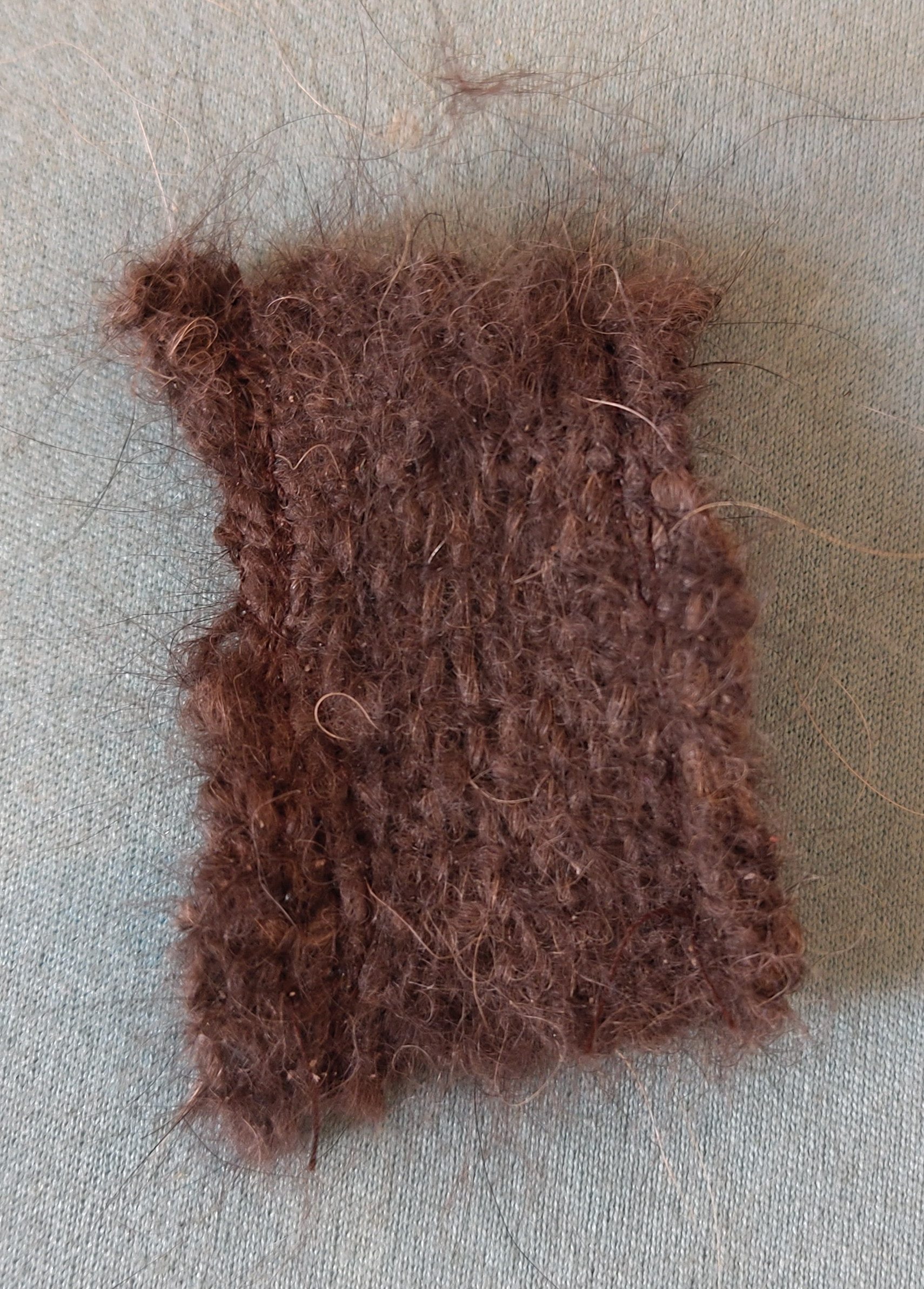
<p>I made a piece of fabric over the last weekend. Completely with things I had lying around the house. It is a very small piece of fabric, hemmed on my sewing machine and it may not seem like much, but as I go through the process I hope you will see why I find it to be important.</p>

<p><a href="/assets/images/spinning/FabricSwatch.png"><img class="diyImage" src="/assets/images/spinning/FabricSwatch.png" style="width: 150px;" alt="a swatch of gray fabric" /></a></p>

<h2 id="step-1-get-a-dog">Step 1: Get a dog?</h2>
<p>So, this project was only possible thanks to Atlas. He is a 70kg (135 lbs) Bernersennenhund/Pyrenäen cross (Bernese Mountain Dog/Great Pyreneese), and the source of that swatch of fabric up there. 
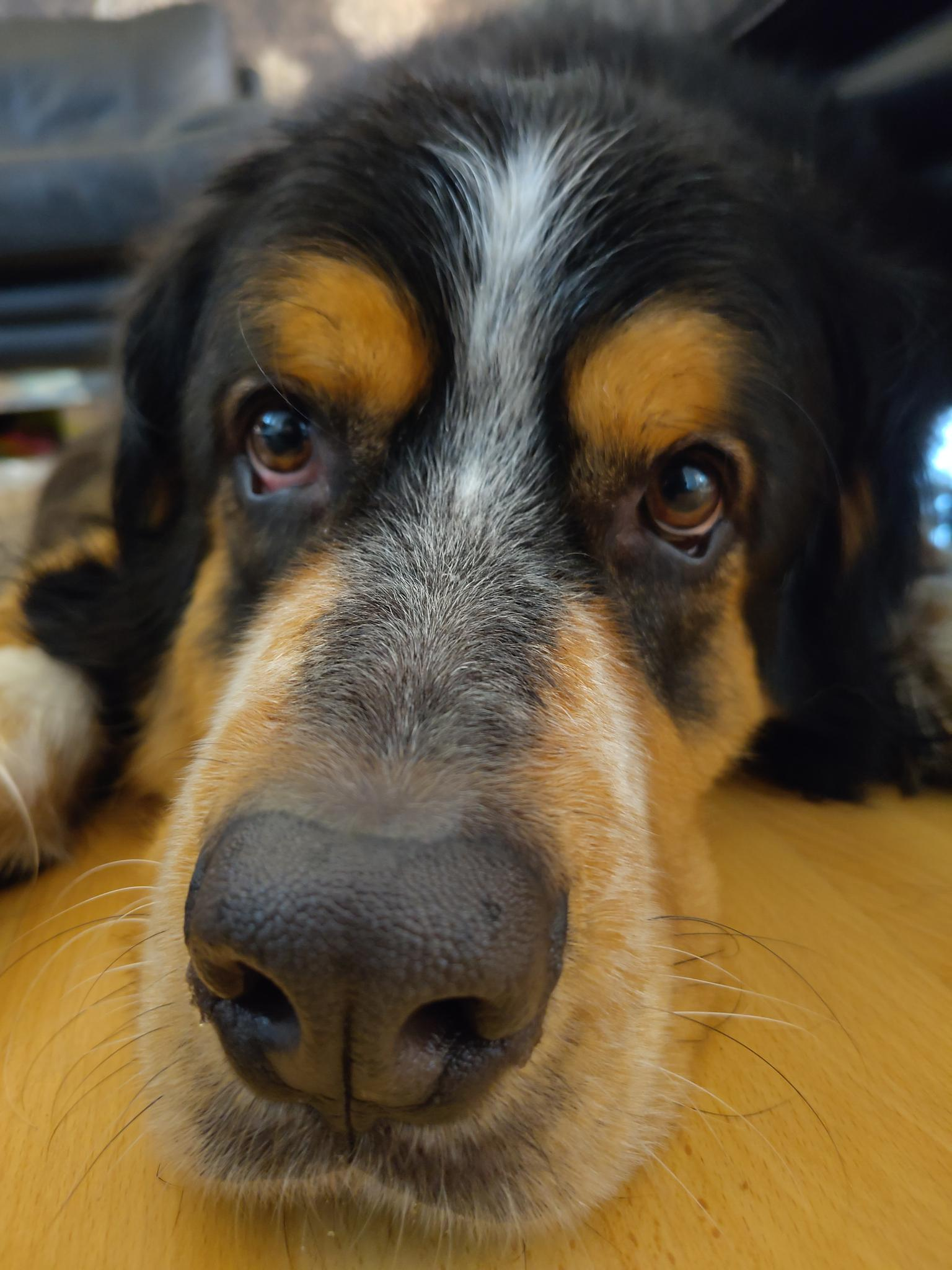
<a href="/assets/images/spinning/atlas.png"><img class="diyImage" src="/assets/images/spinning/atlas.png" style="width: 150px;" alt="a big o' Doggo looking at the Camera" /></a>
My spouse was kind enough to save his fur while grooming him for me to turn into fabric, yarn, and string. I have a whole bag of the stuff, but this is a nice fluffy pile: 
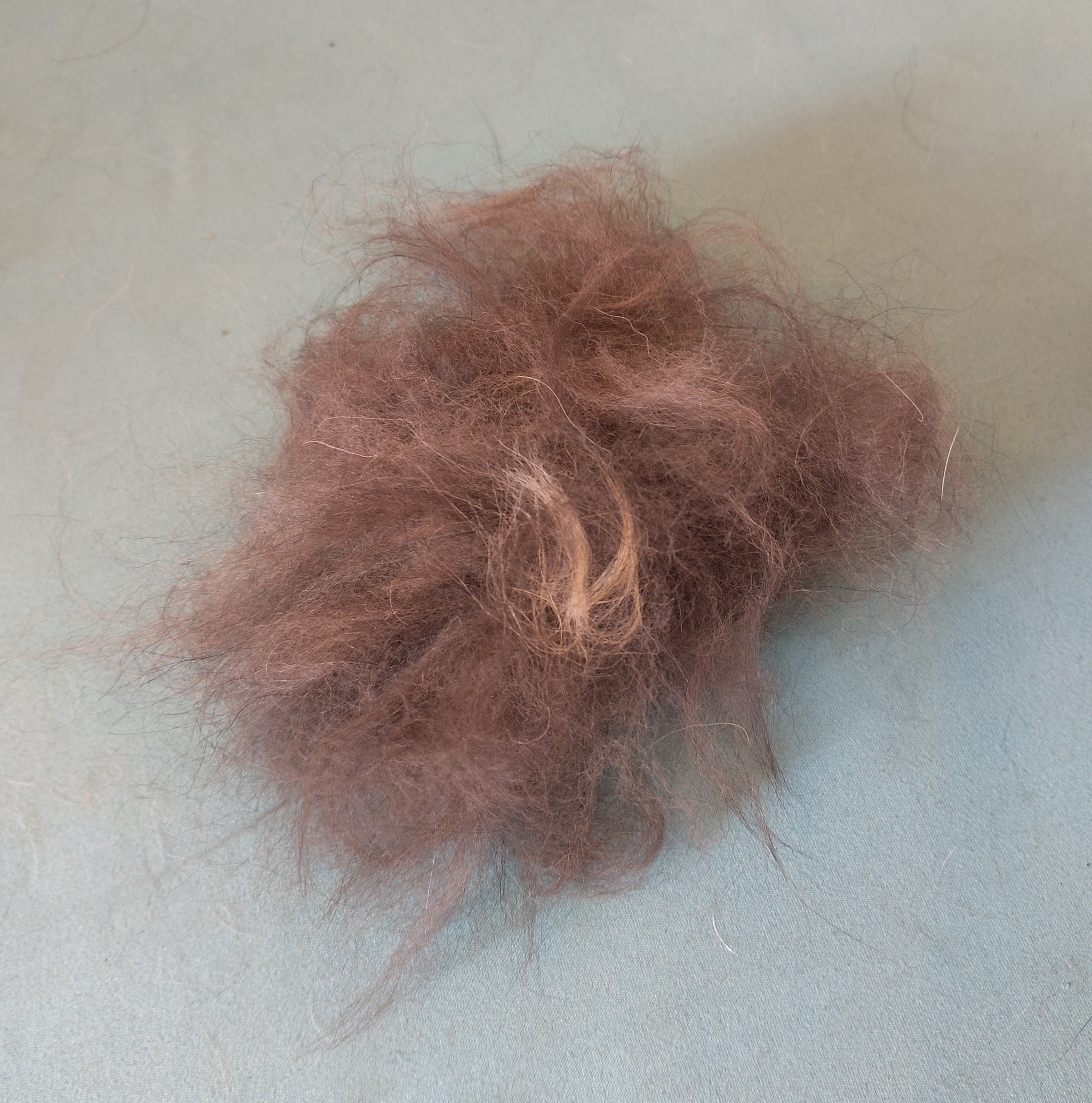
<a href="/assets/images/spinning/fur.png"><img class="diyImage" src="/assets/images/spinning/fur.png" style="width: 150px;" alt="a pile of Atlas Fur" /></a></p>

<h2 id="step-2-eat-too-much-asian-carryout-and-make-a-spindle">Step 2: Eat too much Asian carryout and make a spindle.</h2>
<p>Almost everything I used for this project is made of yarn and chopsticks. Why? Because I had them. I have used fancy spinning wheels in the past, but a drop spindle is the most period accurate for <a href="Aethelric.html">Æthelric</a>. I plan to go out to a park, find a nice straight stick, and try making a more period-appropriate spindle. For now, I have chopstick spindle. 
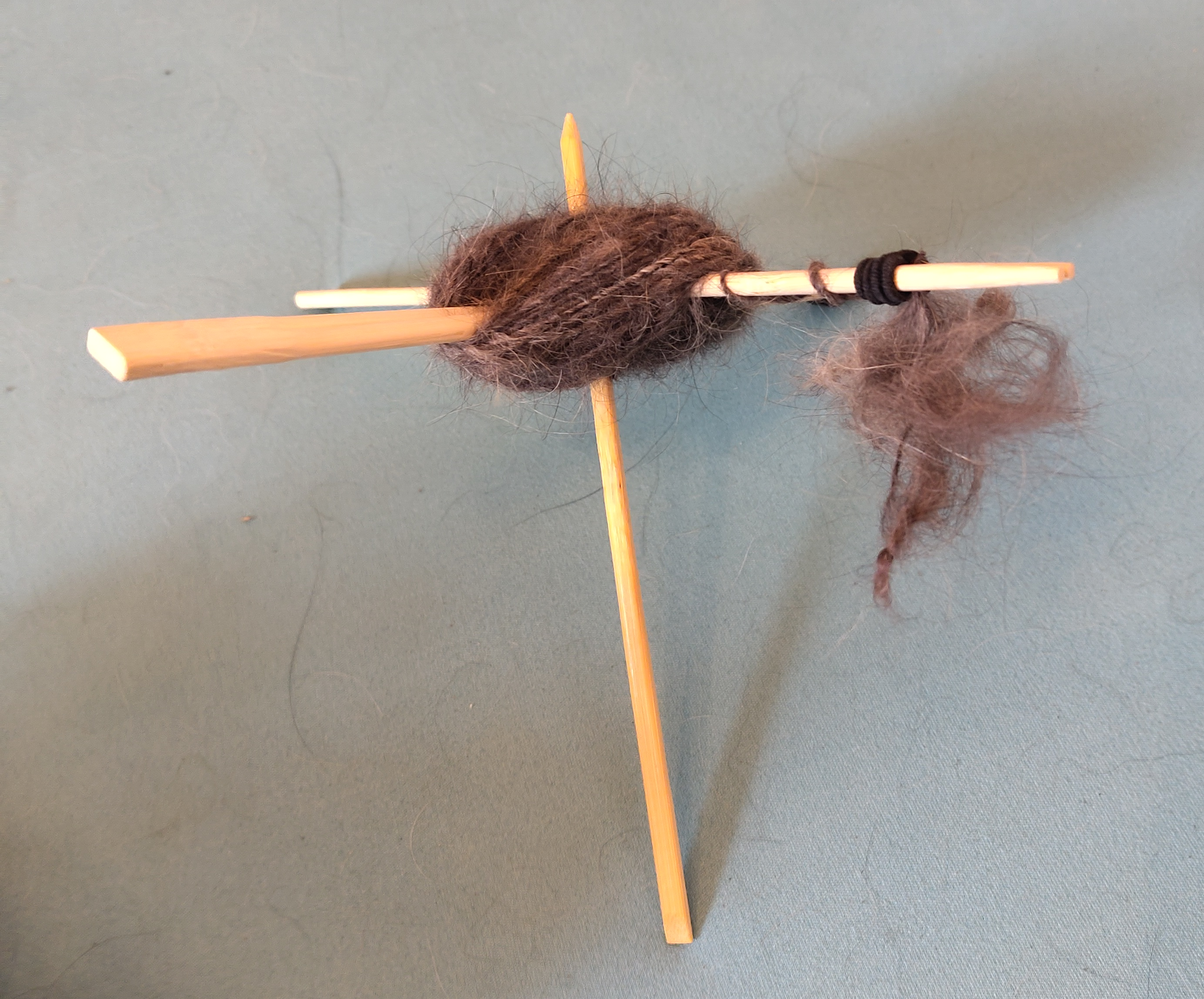
<a href="/assets/images/spinning/spindle.png"><img class="diyImage" src="/assets/images/spinning/spindle.png" style="width: 250px;" alt="a drop spindle made of chopsticks" /></a>
There may be some purists out there reading this cringing that I have not discussed washing or carding this fur. That is because I didn’t! :D</p>

<p>I will wash the fabric, and yarn if I ply it to get the oils out. I remove anything else I find in his fur while spinning. As fur (ha) carding, I do not see a need to when spinning dog fur. I have carded the fur in the past, and I haven’t found a lot of difference in how it spins. This seems to work well enough.</p>

<p>For what it’s worth, I do tuft it out by hand before spinning it, so that does some alignment of the fur.</p>

<p>The spindle is made by putting two pairs of chopsticks at a 90 degree angle to each other around a central spindle. I did carve some notches in the central staff of the spindle to keep them in position. I kept the chopsticks unbroken on one side, and then used hair ties (yarn lashing would work here) on the open ends to hold them onto the spindle by tension.</p>

<h2 id="step-3-more-chopsticks">Step 3: MORE CHOPSTICKS!</h2>
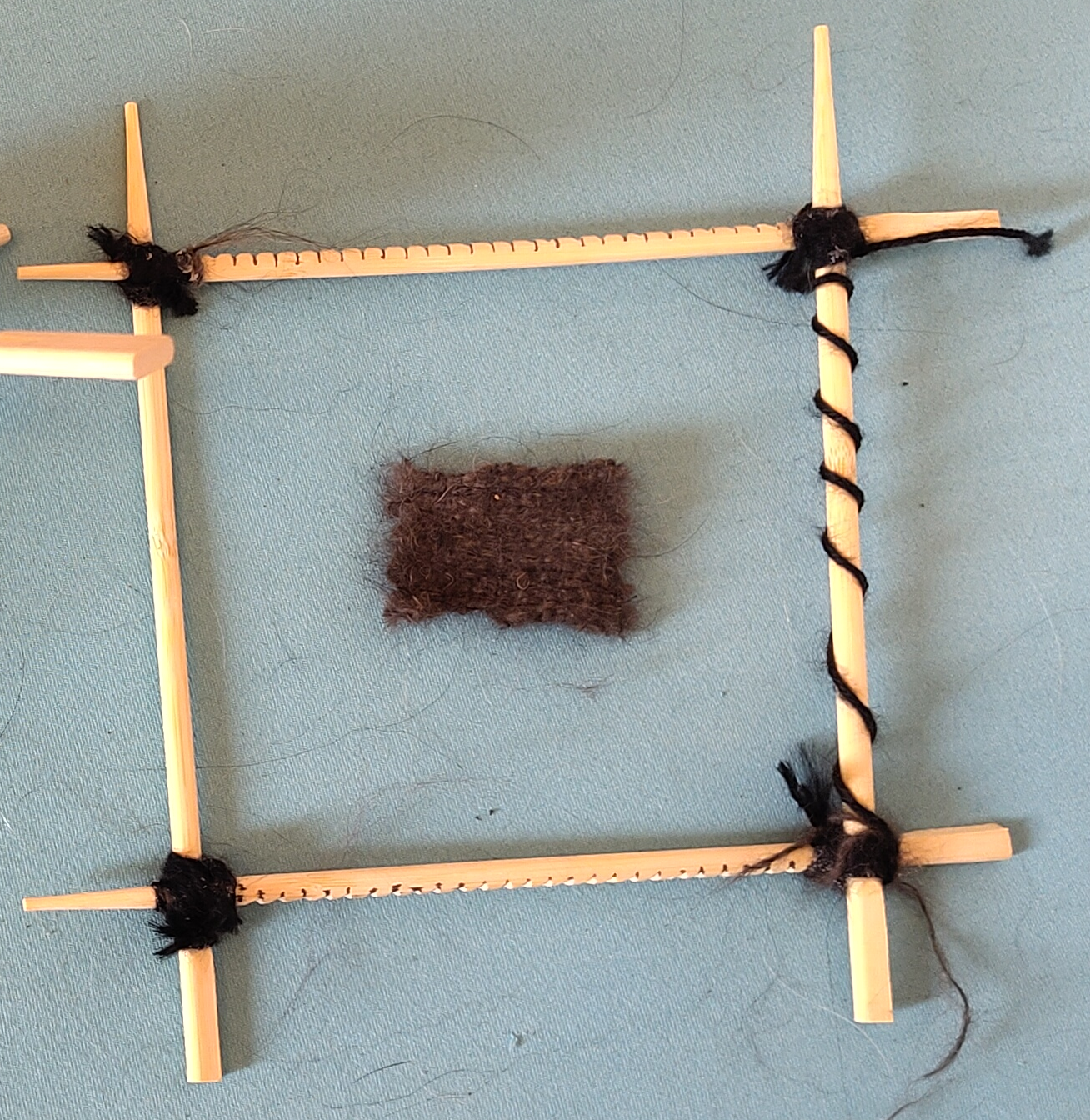
<p>After spinning the fur on the drop spindle, I warped up a little frame loom that I lashed together with yarn and chopsticks. (Chopsticks are a fantastic tool. I don’t know what to tell you.)
I used a file to make some notches 5mm apart to keep the threads sorted. (I also used a chopstick as a shuttle. :D)</p>

<p><a href="/assets/images/spinning/loom.png"><img class="diyImage" src="/assets/images/spinning/loom.png" style="width: 250px;" alt="a loom made of chopsticks" /></a></p>

<p>On this loom, I wove the sample fabric above with a simple plain-weave pattern. (For those not in the loop on that, a plain weave is over-under-over-under and is the simplest form of weave.)</p>

<h2 id="some-thoughts">Some Thoughts</h2>
<p>I really like Fibre Arts, so I am a bit biased, but having a hand-spun, hand-woven swatch of test fabric is pretty amazing to me. I do plan to make a tunic this way after I have moved to more permanent housing and can set up a warp-weighted loom. For right now though, I have plenty of work just spinning the threads!</p>

<p>The complete set of tools and a rough order of the fabric was created were pretty simple to make, and if you have a dog and a free weekend, it might be worth giving a try! 
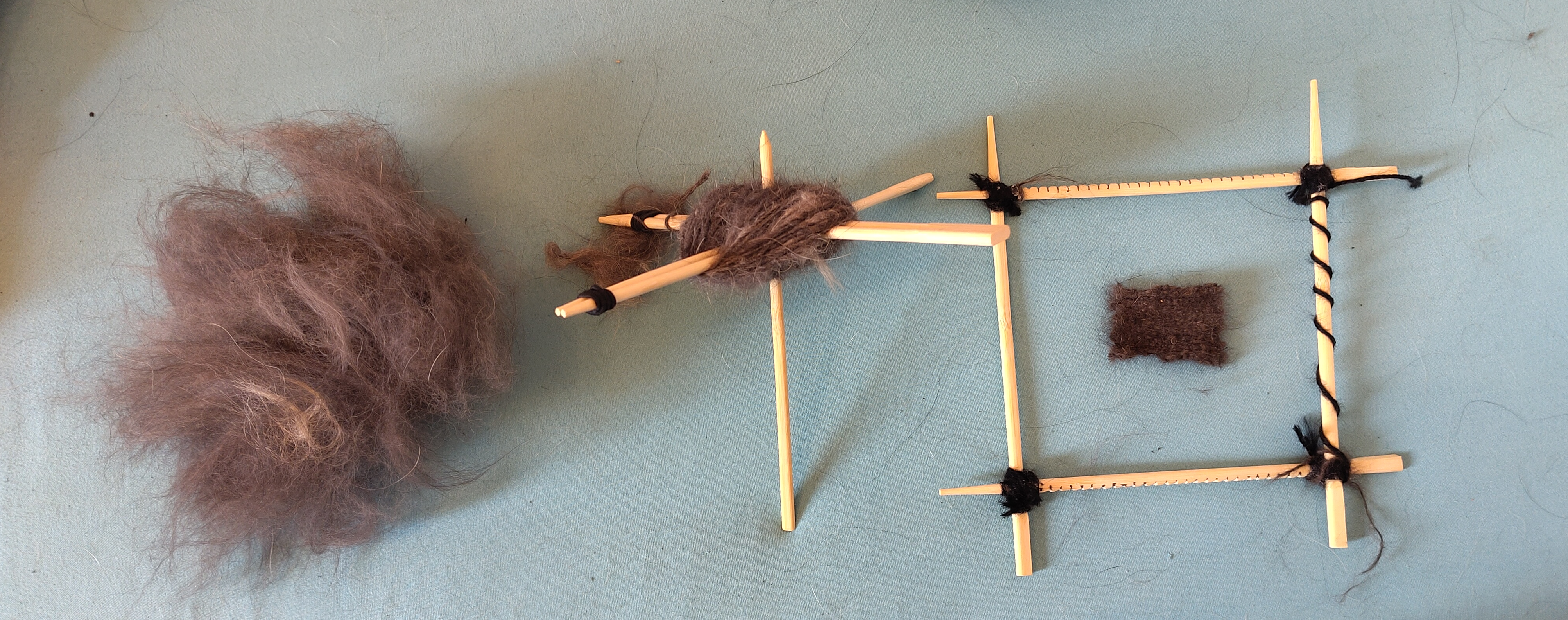
<a href="/assets/images/spinning/CompleteSet.png"><img class="diyImage" src="/assets/images/spinning/CompleteSet.png" style="width: 250px;" alt="a complete set of fabric making tools made with chopsticks, yarn, and dog fur." /></a></p>]]></content><author><name></name></author><summary type="html"><![CDATA[Some Notes on Spinning]]></summary></entry><entry><title type="html">Personae</title><link href="https://j4yc33.neocities.org/LARP/Aethelric.html" rel="alternate" type="text/html" title="Personae" /><published>2026-09-09T18:39:10+02:00</published><updated>2026-09-09T18:39:10+02:00</updated><id>https://j4yc33.neocities.org/LARP/Aethelric</id><content type="html" xml:base="https://j4yc33.neocities.org/LARP/Aethelric.html"><![CDATA[<h1 id="personae">Personae</h1>
<p>These are the Personae I have.</p>

<h2 id="my-main-persona-æthelric-the-smith">My main Persona: Æthelric the Smith</h2>
<p>My persona, subject to Heraldic approval as of April the 10th, 2026, is Æthelric the Blacksmith. I was born in the year of our Lord 780 in a hamlet outside of the market at Hamwic in the Kingdom of Wessex. In the last year I have left my small hamlet to return to Saxony. Presently, I am a subject of the Canton of Bärenau in the Barony of Knight’s Crossing in the Kingdom of Drachenwald. I am hoping to bring my training as a Blacksmith to my small village, and contribute to the sufficiency and growth thereof.</p>

<p>I am a generally skilled Blacksmith with some basic skill in Carpentry, the making of clothes, and cookery. No more than most would have, other than Carpentry as that was the trade of my father. I am literate by sheer force of will, and exposure to texts in the Market. I play the lyre and sing as a hobby. In my past I have been service in the militia in minor conflicts with the Normen near the borders of Mercia. This has given me some skill with an Axe, Spear, and Sword as weapons of war. I lead a fyrd of 20 men in my last posted conflict.</p>

<p>I have also answered a <a href="/Persona/Questionnaire.html">questionnaire</a> about Æthelric with 70 questions about my history and life. ß</p>]]></content><author><name></name></author><summary type="html"><![CDATA[Personae These are the Personae I have.]]></summary></entry></feed>